Friday, January 24, 2014

LISTENING: The part of communication that is IGNORED!

“The most important thing in communication is to hear what isn’t being said” 
–Peter Drucker, Management Theorist


While expressing your thoughts in a coercive, powerful manner is crucial to being a good communicator and manager, this is, in fact, only half of the battle won. The other, equally important aspect of good communication involves developing your listening skills.

As a manager, good listening skills are especially important to you in order to help you develop a better rapport with your team members, understand and hence resolve any problems with customers and colleagues more effectively, and to ‘read between the lines’ more adeptly to gain a clearer understanding of how well or otherwise your audience is responding to you.

The first step towards developing good listening skills is to want and consciously intend to do so. The second step is to acquire and master certain behaviors that will help you to be a better listener.


1. Know your objective

Determine the purpose for, or objective of, your listening. For instance, you could be trying to empathize with someone, or analyze or solve problems when communicating with someone else.

Being clear about your objective will help you to be more receptive to cues in the conversation, and hence sift through all the clutter to retain only those bits that are most pertinent to you. Knowing your objective will prove invaluable in situations where the person you are conversing with either rambles, or talks about multiple topics as the same time.

2. Actively interact

While being a patient, quiet listener has traditionally been confused with being a ‘good listener’, it is important that you learn to distinguish between the two. A quiet listener may not gain complete understanding of what is being communicated to him/her, and will also fail to inspire confidence in the speaker since he/she is unsure about whether or not he/she has succeeded in capturing your attention.

Communicate your interest by asking questions, seek clarifications where required, and even feel free to disagree in case of differences in opinion. Further, when asking questions, prefer ‘how’ and ‘why’ questions that require a certain amount of elaboration, as opposed to those that can be answered with a simple ‘yes’ or ‘no’.

3. Stay focussed

Simple as it may seem, but focus is probably both the most important and most difficult of all listening skills. Listening well requires self-control and to not allow your mind to drift into random thoughts. Consider the case of a college lecture: most students accurately comprehend and retain only about half of what they hear in a 10-minute period. Therefore, students who can stay mentally engaged and focused on listening to their instructors during class stand a much better chance of learning the material presented, and accurately applying it in assignments and examinations.

One way to increase your focus is to first be clear about your objective, and subsequently the value you will gain from the interaction. In the case of a lecture, for example, tell yourself that you are going to find some nugget of valuable information or thought stimulator in what you are about to hear. Think of it as a treasure hunt, a game or a challenge, and you will automatically find it much easier to stay interested and hence, focused, on the interaction.

Monday, January 13, 2014

Working from 'The Center for Agile Thinking' HQ!

The new year started with a big bang at both the Last-Bench! office in Mumbai and The Center for Agile Thinking office in US. The boys in Mumbai have been on a roll and continuously producing learning content. I'd like to share my experience working out of The Center for Agile Thinking HQ in Princeton, New Jersey.

Work as usual started from the 1st day of January. That I'd like to call #LifeOfAnEntrepreneur. Prof. Anne, Charlie and I started work with getting an agenda down first of what we wanted to accomplish over the next 4 days. We came up with a list of 9 items and we achieved 8 out of them, which was very exciting!

The day started out with coffee, went into discussions, ideations and brainstorming. We also got down to some real work which included content and technology. I got to meet a very interesting management consultant while I was there with whom we validated our product, idea and value proposition.

Charlie and I got our hands wet with some server issues, discussed wireframes, design and user-interface. Prof. Anne and I reviewed content for some of our offerings. We had our first virtual team meeting with Sajid and Venkat in India and I was here in the US. It felt a bit different but the feeling was good.

Our days started at around 8am and went on until 8-10pm but it never felt tiring or stressful. Intermittently, our conversations ranged from culture to experiences, which maintained the balance and equilibrium in our minds!:-) I learned Charlie is an awesome musician who also learnt from Pt. Ravi Shankar back during his college days. He played the Piano on one of the evenings as we all were relaxing and it was perfect! The music was relaxing and it got us energized. He played Jazz to Classic Rock. I didn't know a whole lot of Jazz but he played Eric Clapton, Led Zeppelin, Deep Purple and Billy Joel. What an experience to see him play the Piano!

Even on the last day, usually one would feel relaxed but we were on a roll and got a lot of work done on the final day too. With al the work, I was balancing calls and work back in India and tried in whatever little way I could to support the team in every possible manner which included communicating all our discussions here with Sajid and Venkat too.

Prof. Anne and Charlie were great hosts. For me, it felt like home and working from the office was the best start to the New Year!

Here are some pics:


Monday, December 30, 2013

Into 2014 and beyond!

2013 has been a great learning year at Last-Bench! We’ve had our shares of ups and downs, successes and failures, good days and bad days and busy days to extremely busy days but with all this we fought all odds and are now moving into our third year of existence – 2014.


From a team perspective, we’ve had many interns coming in and continuing on with their journey but towards the end our team size increased by 1. Though it’s just one but the importance of adding that ONE right person in your team is probably one of the best things that could’ve happened that will help us towards achieving our goals.

As we move into 2014, the LB team will focus on two major areas, which we do with passion, possess the right skills to execute and can make substantial progress from a business perspective.

  • Educational content production
  • Learning platform
Our content production projects are already rolling and we’re looking to scale it big time. We’ve already got multiple projects ranging from Kindergarten content to K-12 and corporate skill development content production in the pipeline for execution and will be scaling our team by 200% to support development activities. Overall, we’re seeing this as a big potential this year and in the future too. All I can say for now is, content production is not easy and we’ve mastered the art to bring creativity and smooth execution to the madness in this method.

On the other front, we’re very close on getting our learning platform MVP ready and are planning a soft launch sometime in Jan 2014 itself. Our JV partners and us have put a lot of thought into planning the strategy, technology, content and sales and finally in the last quarter of 2013, we began the development from all angles. We’re very excited about this learning solution and will be competing against the biggies in this space but in a very niche area. To give you’ll a gist, we’re building an expert driven skill development community for working professionals and are already seeing interest from our potential target customers.

To reach to this point today, I can proudly say that we’ve done it without external funding and are able to sustain our operations ourselves without having to put in more money after the initial capital. Like I’ve always said, it’s the team that matters and the team that can execute matters even more and at Last-Bench! we’ve got the team that can execute.

Keep a lookout on all the exciting stuff that we’re going to showcase in 2014. It’s the year where you’ll be hearing a lot about our work and us!

Lastly, would like to thank all our stakeholders for helping us to get to where we are today! We need your continued support.

Signing off from Munich! See you in 2014. Happy New Year!


-Rajeev (#LifeOfAnEntrepreneur)

Sunday, December 29, 2013

End of year celebrations at Last-Bench!

Yet another exciting, eventful and jam-packed year draws to a close and, as a tradition, it marks the return of the annual Last-Bench festivities. This year we got everyone together for a nice sit-down dinner with loads of delicious food, fun, frolic and conversation, not to forget the collective reflection on a year that has been momentous for the company. This year we didn't just welcome business growth, new team members, new strategic partnerships and new services and offerings but also two adorable babies - Hanika Chhajer and Alishka Mehra - into the Last-Bench fam-fam. As you can see, a truly encouraging year and the dawn of an even more exciting future. 

Here are some pics from the night:


Thanks to the entire team, their families, our advisors who came out to celebrate this fantastic year and to all our fans and well-wishers who were present in spirit :) Looking forward to an even better 2014!!!

Thursday, December 12, 2013

Emotions impacting TEAMS!

"Team player", "Team", "Teamwork" - are terms that are so so so often used in our lives whether it's at college or getting your first job and even as we progress in our careers. Everybody as an individual talks about being a team player and many of us are true team players too.


Everybody knows the traditional definition of a TEAM and what it takes to be a team-player but in this blog I'll talk about something more deeper than accomplishing a common task. I'm going to talk about the impact of EMOTIONS in accomplishing that one common task.

Let's boil down a team of 'x' members to a team with just one member - that's you. Now imagine, you're working on a project to accomplish a goal. You set a plan and start executing the plan. The good thing about this project is that there are no external dependencies so it's perfect right! You don't have to depend on anyone to move forward in your project. The first few days are super, you put in the 10-12 hours daily and everything goes well the first week. By the end of the week you're extremely motivated and plan your task for the next week. On completion of your week 1, you decide to take it easy over the weekend and go out with your friends for a drink. The party you thought would get over by early night really ended the next day morning. You're extremely tired and want to hit the sack as soon as you reach home. So now your weekend goes for a toss and you're running a bit late on your schedule but no worries still. You're motivated and tell you're self that I'll cover up in the coming week. You then begin your work motivated but then at the start of the week itself run into major technical issues and start getting worked up because you're not able to solve them. You put in another day's effort but still the issues dont get resolved. Finally, you decide to make some desperate calls and you don't find the intended solutions. You've started to get a headache and just try to get some rest. Once you're up, you think about the situations and start getting angry at the fact if you hadnt partied, you could've got 2 additional days. Everything starts turning glum and demotivation starts setting in. Your project now takes 5 weeks to complete that could've just taken 2.

What I want to highlight with this story is that with a 1-member team and no external dependencies things can go for a toss due to the impact of emotions. In this example, it started with high motivation, happiness, sense of accomplishment, relaxation then turned into extreme stress, anger and demotivation.

Now imagine a bigger team. Everyone in the team when working towards a common goal bring a wide range of emotions towards the work. Some of the members may be very highly motivated and think about the organizations success, some may be highly motivated but may think only about their success in the goal, some members may just be doing the tasks for the sake of doing them and instead prove to be a hindrance in other's work too and some may bring their outside emotion to work maybe like a fight in the family, a sudden loss, failure or success and even internal/external competition.

The bigger task is for the leader who needs to manage everybody's emotions and also his/her own emotions while working on achieving targets.

So for the leaders out there: achieving your goals with your team is one thing but managing your team members emotions while achieving goals is a whole new story!

Monday, December 9, 2013

Halfway through the 'Startup Leadership Program': Thoughts & Learnings

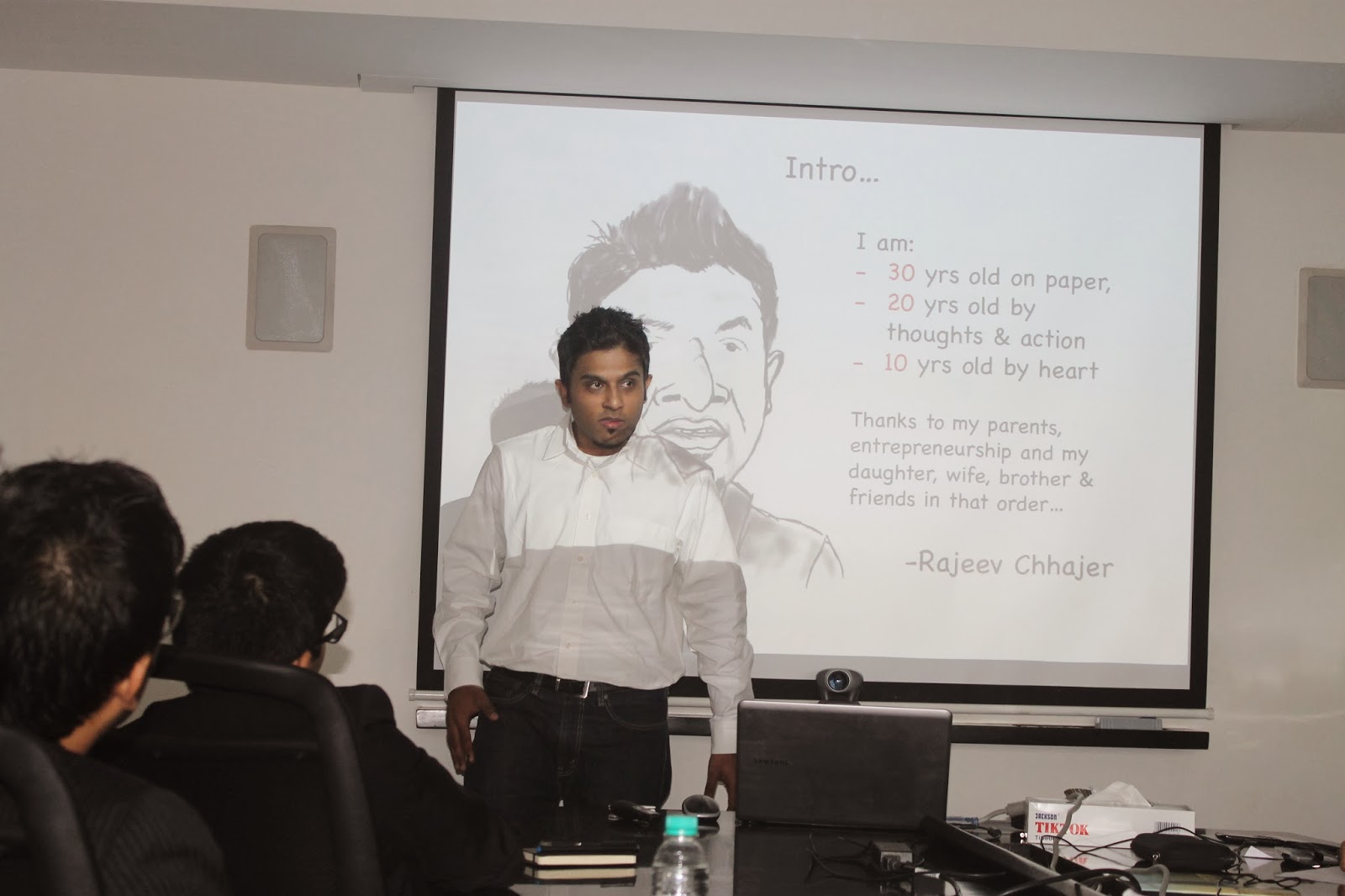
It was a couple months back when I heard about the Startup Leadership Program (http://www.startupleadership.com). I read about it, found it interesting and started reading more about how I could enroll. To my surprise, there was a selection process. This in a way was a roadblock because I was in no mood to write essays. Anyway, I thought about it deeper and somewhere I felt like this program would help me take my startup to a very different level so I took a stab at the essays and the admission form. With the daily grind, somewhere I forgot that I had applied. Finally, out of the blue I got a call and coordinator told me I got selected! Yippiee!! :-) I was really excited about this community!

As I write this blog, I'm somewhere in the middle of the entire 6 month program. The program has been very enlightening, eye-opening and a great learning experience. I've met some amazing and enthusiastic budding entrepreneurs, successful entrepreneurs and investors. Every session has so much to take away. We've covered topics on business plans, pitches, financial modeling, customer development, valuations, products, investments, lean methods, sales, customer development and many more exciting topics to come as we move ahead.

I got to meet with some very exciting entrepreneurs, Nischal from JustUnfollow, Sampad from Instamojo, Pravin from Wishberg, Kunal from Freecharge, Vikram from MyDentist, Mohit from Carwale, Sameer from CouponDunia, Vikram from yavvy.com and Bijaei from Loyalty Rewardz.

But I'd like to share my learnings till date and how I have implemented it within Last-Bench! One of our biggest strengths as a startup is that we have a strong, dependable and multi-talented team. It might not be large but it is a team whose strengths are diverse and individually each member, using their unique talent,  contributes to the business goals in a unified manner. One of our biggest weaknesses is the constant pivoting and loss of focus when trying to experiment with too many things.

As part of our lean method, the first thing we did was clearly identify the areas (product and services) we want to work on. We chose 1 product and 1 service that we wanted to focus on. This is helping us to be more focused and also allowing us to channel our energies in the right direction. Second, we've decided that each one manages his own time but wherever dependencies, that person is responsible to coordinate with the other people so that a bigger weekly goal is achieved. Third, we've started weekly targets that sum up to the bigger targets and everyone needs to report whether it is completed or not. There is no room to say that it is partially completed or 50-60% completed. If remaining, simply means it is not done. Fourth, we kept clear goals in terms of revenue and product development. Fifth, experimentation is key to find out whether a feature or a sales method will work for us or not. Sixth, there is no room for assumptions. Seventh and the most important, keep having fun while working!

Before and after every session I share the learnings with my team and everybody is excited to learn more. I personally think, a program like this, is definitely good for entrepreneurs who are in the 1st two years or to-be entrepreneurs. The biggest advantage that this program brings is the discipline!

Here are some pics from the sessions:


I will write more on this once the program ends and share my learning on each topic as we progress.

You can follow Rajeev on Twitter or connect with him via LinkedIn

Monday, December 2, 2013

Leader in focus: Warren Buffet

What really separates average leaders from the great ones? To get to a leadership position and, more importantly, to stay in one you not only require determination, courage and vision but also some very important skills to help you accomplish the work you are entrusted to complete. In business, it is equally important that you must be flexible and adaptive to constantly changing climates and demands. So is it possible to zero in on what is common between all great leaders? Can we learn from the way they plan, execute and achieve?