Showing posts with label leadership. Show all posts

Friday, January 24, 2014

LISTENING: The part of communication that is IGNORED!

“The most important thing in communication is to hear what isn’t being said” 
–Peter Drucker, Management Theorist


While expressing your thoughts in a coercive, powerful manner is crucial to being a good communicator and manager, this is, in fact, only half of the battle won. The other, equally important aspect of good communication involves developing your listening skills.

As a manager, good listening skills are especially important to you in order to help you develop a better rapport with your team members, understand and hence resolve any problems with customers and colleagues more effectively, and to ‘read between the lines’ more adeptly to gain a clearer understanding of how well or otherwise your audience is responding to you.

The first step towards developing good listening skills is to want and consciously intend to do so. The second step is to acquire and master certain behaviors that will help you to be a better listener.


1. Know your objective

Determine the purpose for, or objective of, your listening. For instance, you could be trying to empathize with someone, or analyze or solve problems when communicating with someone else.

Being clear about your objective will help you to be more receptive to cues in the conversation, and hence sift through all the clutter to retain only those bits that are most pertinent to you. Knowing your objective will prove invaluable in situations where the person you are conversing with either rambles, or talks about multiple topics as the same time.

2. Actively interact

While being a patient, quiet listener has traditionally been confused with being a ‘good listener’, it is important that you learn to distinguish between the two. A quiet listener may not gain complete understanding of what is being communicated to him/her, and will also fail to inspire confidence in the speaker since he/she is unsure about whether or not he/she has succeeded in capturing your attention.

Communicate your interest by asking questions, seek clarifications where required, and even feel free to disagree in case of differences in opinion. Further, when asking questions, prefer ‘how’ and ‘why’ questions that require a certain amount of elaboration, as opposed to those that can be answered with a simple ‘yes’ or ‘no’.

3. Stay focussed

Simple as it may seem, but focus is probably both the most important and most difficult of all listening skills. Listening well requires self-control and to not allow your mind to drift into random thoughts. Consider the case of a college lecture: most students accurately comprehend and retain only about half of what they hear in a 10-minute period. Therefore, students who can stay mentally engaged and focused on listening to their instructors during class stand a much better chance of learning the material presented, and accurately applying it in assignments and examinations.

One way to increase your focus is to first be clear about your objective, and subsequently the value you will gain from the interaction. In the case of a lecture, for example, tell yourself that you are going to find some nugget of valuable information or thought stimulator in what you are about to hear. Think of it as a treasure hunt, a game or a challenge, and you will automatically find it much easier to stay interested and hence, focused, on the interaction.

Monday, December 9, 2013

Halfway through the 'Startup Leadership Program': Thoughts & Learnings

It was a couple months back when I heard about the Startup Leadership Program (http://www.startupleadership.com). I read about it, found it interesting and started reading more about how I could enroll. To my surprise, there was a selection process. This in a way was a roadblock because I was in no mood to write essays. Anyway, I thought about it deeper and somewhere I felt like this program would help me take my startup to a very different level so I took a stab at the essays and the admission form. With the daily grind, somewhere I forgot that I had applied. Finally, out of the blue I got a call and coordinator told me I got selected! Yippiee!! :-) I was really excited about this community!

As I write this blog, I'm somewhere in the middle of the entire 6 month program. The program has been very enlightening, eye-opening and a great learning experience. I've met some amazing and enthusiastic budding entrepreneurs, successful entrepreneurs and investors. Every session has so much to take away. We've covered topics on business plans, pitches, financial modeling, customer development, valuations, products, investments, lean methods, sales, customer development and many more exciting topics to come as we move ahead.

I got to meet with some very exciting entrepreneurs, Nischal from JustUnfollow, Sampad from Instamojo, Pravin from Wishberg, Kunal from Freecharge, Vikram from MyDentist, Mohit from Carwale, Sameer from CouponDunia, Vikram from yavvy.com and Bijaei from Loyalty Rewardz.

But I'd like to share my learnings till date and how I have implemented it within Last-Bench! One of our biggest strengths as a startup is that we have a strong, dependable and multi-talented team. It might not be large but it is a team whose strengths are diverse and individually each member, using their unique talent,  contributes to the business goals in a unified manner. One of our biggest weaknesses is the constant pivoting and loss of focus when trying to experiment with too many things.

As part of our lean method, the first thing we did was clearly identify the areas (product and services) we want to work on. We chose 1 product and 1 service that we wanted to focus on. This is helping us to be more focused and also allowing us to channel our energies in the right direction. Second, we've decided that each one manages his own time but wherever dependencies, that person is responsible to coordinate with the other people so that a bigger weekly goal is achieved. Third, we've started weekly targets that sum up to the bigger targets and everyone needs to report whether it is completed or not. There is no room to say that it is partially completed or 50-60% completed. If remaining, simply means it is not done. Fourth, we kept clear goals in terms of revenue and product development. Fifth, experimentation is key to find out whether a feature or a sales method will work for us or not. Sixth, there is no room for assumptions. Seventh and the most important, keep having fun while working!

Before and after every session I share the learnings with my team and everybody is excited to learn more. I personally think, a program like this, is definitely good for entrepreneurs who are in the 1st two years or to-be entrepreneurs. The biggest advantage that this program brings is the discipline!

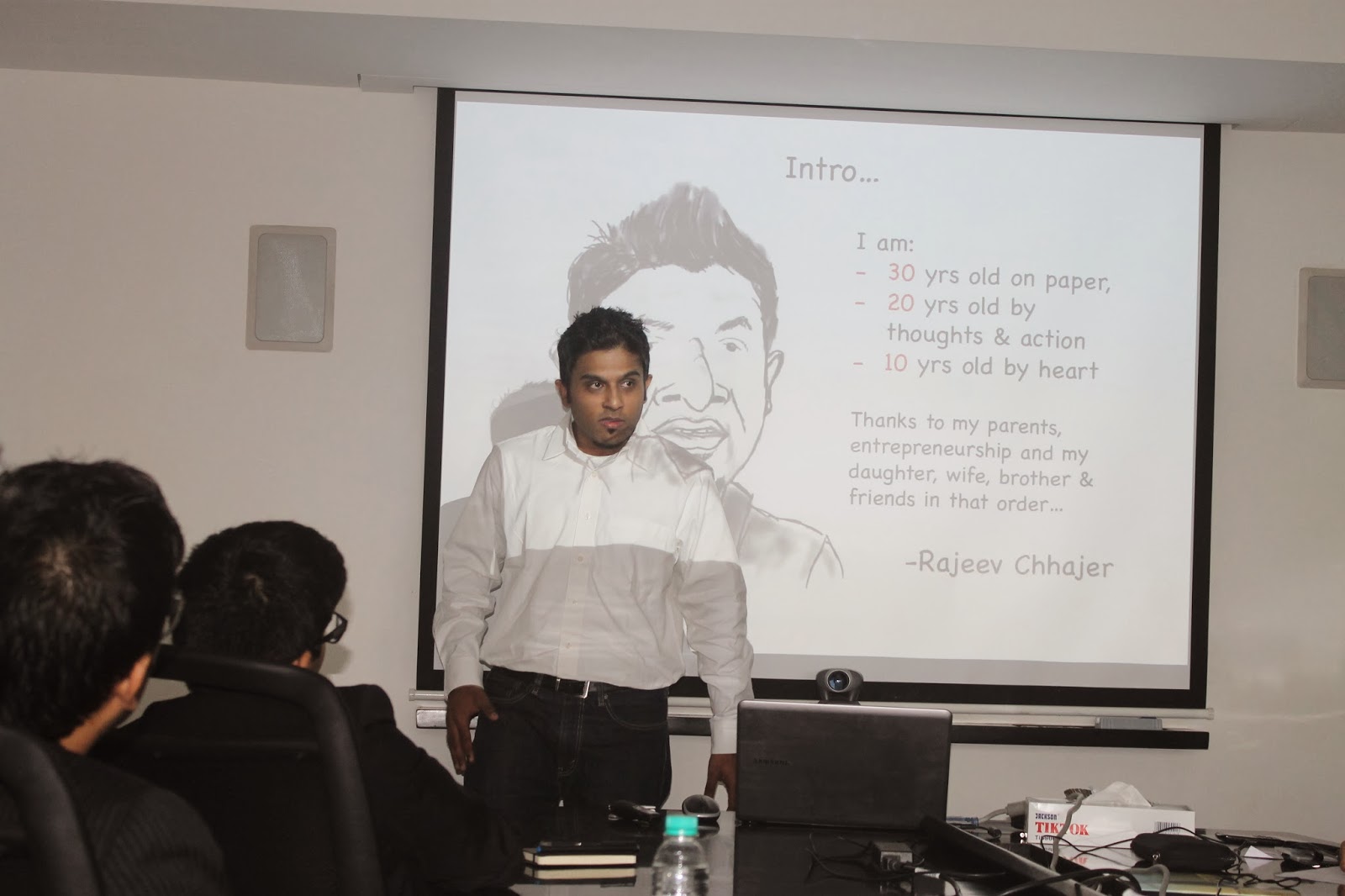
Here are some pics from the sessions:


I will write more on this once the program ends and share my learning on each topic as we progress.

You can follow Rajeev on Twitter or connect with him via LinkedIn

Monday, December 2, 2013

Leader in focus: Warren Buffet

What really separates average leaders from the great ones? To get to a leadership position and, more importantly, to stay in one you not only require determination, courage and vision but also some very important skills to help you accomplish the work you are entrusted to complete. In business, it is equally important that you must be flexible and adaptive to constantly changing climates and demands. So is it possible to zero in on what is common between all great leaders? Can we learn from the way they plan, execute and achieve?

Monday, November 25, 2013

Leading Today's Business Organizations


The current business environment is extraordinarily challenging, competitive and dynamic. Companies need young professionals who can make an immediate impact on their organizations and also individually grow as the company is growing. Business knowledge, management & leadership skills are critical assets for success in almost any career. 

A lot of students entering the workforce or people already in the workforce are from non-business backgrounds such as engineering, science, medicine, arts or the finance streams and now find themselves on career tracks where they need to understand and “speak” the language of business fluently. Others are entrepreneurs who need to stay ahead of the curve in order for their business to succeed and grow. In any case, you need the business, management & leadership skills to advance your career to the next level.

In the past, when organizations followed a more pyramid-type structure, leaders were invested with far more formal authority. These leaders could issue directives, which would be funneled down through the various organizational ranks.  As such, the edicts issued by the leadership carried an enormous amount of organizational weight. Today’s organizations, however, are flatter. The degree of formal authority invested with leaders is much lower than before, and, given the modern-day organizational structure, many leaders do not particularly this authority particularly useful. Instead, they have learned to rely more on their own mastery of certain skills, and focus on learning and developing the same.

While different leaders follow different styles of leadership, there are certain common traits that every leader must possess. These include:
  • Communication skills: To speak and write persuasively
  • Interpersonal skills: To listen and hear what people are saying and react in constructive ways (active listening)
  • Conflict-resolution skills: To handle friction and inevitable tensions
  • Negotiation skills: To bring different groups together in order to reach mutually agreeable goals
  • Motivational skills: To align people who may not report to you toward a goal'
  • Decision-making skills: To take decisions in case of deadlock situations or move towards the larger goal
One of the biggest reasons why most people are so intimidated by the prospect of being a great leader is that only a few truly dare to lead. Indeed, taking up the mantle of leading a team of individuals, many of whom are talented, capable and opinionated, may seem like a daunting task for someone with little or no leadership experience. However, it is this willingness to take on a role and responsibility that others shy away from that sets the stage for a effective, powerful and admirable leader.

Most organizations today are desperately seeking such leaders who will not be afraid to act as pathfinders, visionaries and motivators, creating new avenues for growth for themselves, their teams and their organizations. More than ever, the need for good leaders is large and the opportunity great. To capitalize on this opportunity, however, you must first embrace the fact that leadership comprises multiple dimensions. It is a combination of personal characteristics and transformational behaviors that influence positive action in others. 


If you have any questions, comments or would like to learn more about any of the tools or techniques to improve your soft skills please write to us at chalktalk@last-bench.com

For more information on our skill development programs please click here.

Sunday, November 17, 2013

What makes a great leader?

"Leadership" is a topic that is talked about so much nowadays, it would be safe to say that it's 'in vogue!' Everything you try to do or are doing, you either question yourself or get questioned about whether you're a leader in the particular activity or not. But what really makes a great leader? What separates the 'also rans' from the 'inspiring greats'? What traits or behaviors do great leaders have in common? Can YOU 'learn' how to be a great leader? 

Today, I'm not going to define or explain what  leadership is because there are so many great gurus who have already done so and so many of them who have shown the world by exercising it. Instead, I'll share an experience from my previous job who I thought was a great leader amongst the common folks.

Monday, October 28, 2013

Super Saturday at Bombay Scottish School (Powai)

Saturday mornings, for the majority, are generally reserved for fun and would scarcely be associated with any sort of learning. Hence, when we were approached to conduct a leadership and goal setting session for the students of Bombay Scottish School in Powai, Mumbai on a saturday morning at 9 am, we were a little skeptical. Then we heard there would be kids from grade 6-10 and it got us quite worried. 

Don't get us wrong. We love having sessions with students of all ages, they ask some of the best questions and often think at a level that would put top intellectuals to shame! But, saturday mornings are really when they want to just curl up in bed and look forward to a gigantic brunch comprising pancakes, syrup and tons of chocolate! And here we wanted them to sit through 2 hours of interaction, discussion and brain picking. Uh oh!

Now, in retrospect, we cannot reiterate how wrong we were! Of course, all our sessions are fun-filled, practical and full of activities but this one turned out to be something special. From the offset we realized that we were dealing with smart, enthusiastic and ambitious students. They almost certainly are going to end up right at the top in any career of their choice. Their questions were detailed, thoughtful and insightful. Their comments were crisp, accurate and thought provoking. Their enthusiasm and energy unparalleled. 

Our initial concern was waved off and their confident and pin point reply to our skepticism resonated around the room- 'What Saturday morning blues? We're always ready to learn!'  And then it struck us- these kids have two things which we, individually and as a society, really need - (a) Curiosity and, (b) the Will to Succeed. You almost certainly cannot teach that! It almost felt that by the end of the session we learnt as much, if not more, than this bunch of exemplary, future leaders!

Thank you to all the students who were present for an absolutely wonderful time and an even bigger thanks to the management, principal, teachers and staff of Bombay Scottish School (Powai) for giving us this opportunity. Can't think of a better way to spend a saturday morning :D

Here are some pics:


Thursday, April 25, 2013

Corporate Training Video (demo): 'Giving Effective Feedback'

Check out our brand new corporate training video - 'Giving Effective Feedback'. 

(This video is a demo and we appreciate your feedback and comments. Look out for more such videos. Soon!)

Thursday, September 20, 2012

Soft Skills : The Need to Succeed!

With the traditional paternalistic style of leadership becoming passé, professional managers expect their teams to be proactive and communicate openly. Each company looks for a different mix of skills and experience depending on the business it's in. In fact, it’s pretty tough to predict what they really require from new hires. Is it the ability? Is it the education? Or is it the theoretical prowess? Well, don’t get sleepless nights over what you need to succeed, Last-Bench! has got your back...

Thursday, September 13, 2012

Soft Skills : The ace up your sleeve


"  Soft Skills training is imperative in preparing trainees for jobs that are based on manual or practical activities and to improve behavioural competencies

- Umesh Dhal, VP, HR & MS, LG India


Apart from sales expertise and technical training, it is imperative to provide soft skills training to people on-the-ground for developing their personality, communication and entrepreneurial talent
- Romira Roy, Executive Director-HR, SEED Financial Services        " 

Wednesday, September 5, 2012

E-Cell talk @ SPIT: The Entrepreneurial Experience via Last-Bench!

E-cell invited Last-Bench! to talk to students, faculty, alumni and budding entrepreneurs of SPIT about the initiative, the entrepreneurial experience and our solution to the 'education conundrum'. 

Sunday, August 26, 2012

S.M. Parekh Memorial debate competition at Sardar Patel Institute of Technology : Sponsored by Last-Bench!

A debate competition allows for enterprising and intelligent minds to take stage and express their thoughts and views to an enthusiastic audience. This one was no different.  Last-Bench! had the privilege of sponsoring the annual S.M. Parekh Memorial debate competition at SPIT and, like everyone else present, we were left speechless by the quality of the competition and the array of talent at the event.


Monday, August 20, 2012

Program : MANAGE WHAT


'After one look at this planet any visitor from outer space would say ''I want to see the manager." '

William S. Boroughs


What really makes a good manager? What skills and training do you require? How much experience is needed? How can you apply what you're learning now to a leadership position in the future? One comprehensive answer to worrisome questions - MANAGE WHAT!