Monday, December 30, 2013

Into 2014 and beyond!

2013 has been a great learning year at Last-Bench! We’ve had our shares of ups and downs, successes and failures, good days and bad days and busy days to extremely busy days but with all this we fought all odds and are now moving into our third year of existence – 2014.


From a team perspective, we’ve had many interns coming in and continuing on with their journey but towards the end our team size increased by 1. Though it’s just one but the importance of adding that ONE right person in your team is probably one of the best things that could’ve happened that will help us towards achieving our goals.

As we move into 2014, the LB team will focus on two major areas, which we do with passion, possess the right skills to execute and can make substantial progress from a business perspective.

  • Educational content production
  • Learning platform
Our content production projects are already rolling and we’re looking to scale it big time. We’ve already got multiple projects ranging from Kindergarten content to K-12 and corporate skill development content production in the pipeline for execution and will be scaling our team by 200% to support development activities. Overall, we’re seeing this as a big potential this year and in the future too. All I can say for now is, content production is not easy and we’ve mastered the art to bring creativity and smooth execution to the madness in this method.

On the other front, we’re very close on getting our learning platform MVP ready and are planning a soft launch sometime in Jan 2014 itself. Our JV partners and us have put a lot of thought into planning the strategy, technology, content and sales and finally in the last quarter of 2013, we began the development from all angles. We’re very excited about this learning solution and will be competing against the biggies in this space but in a very niche area. To give you’ll a gist, we’re building an expert driven skill development community for working professionals and are already seeing interest from our potential target customers.

To reach to this point today, I can proudly say that we’ve done it without external funding and are able to sustain our operations ourselves without having to put in more money after the initial capital. Like I’ve always said, it’s the team that matters and the team that can execute matters even more and at Last-Bench! we’ve got the team that can execute.

Keep a lookout on all the exciting stuff that we’re going to showcase in 2014. It’s the year where you’ll be hearing a lot about our work and us!

Lastly, would like to thank all our stakeholders for helping us to get to where we are today! We need your continued support.

Signing off from Munich! See you in 2014. Happy New Year!


-Rajeev (#LifeOfAnEntrepreneur)

Sunday, December 29, 2013

End of year celebrations at Last-Bench!

Yet another exciting, eventful and jam-packed year draws to a close and, as a tradition, it marks the return of the annual Last-Bench festivities. This year we got everyone together for a nice sit-down dinner with loads of delicious food, fun, frolic and conversation, not to forget the collective reflection on a year that has been momentous for the company. This year we didn't just welcome business growth, new team members, new strategic partnerships and new services and offerings but also two adorable babies - Hanika Chhajer and Alishka Mehra - into the Last-Bench fam-fam. As you can see, a truly encouraging year and the dawn of an even more exciting future. 

Here are some pics from the night:


Thanks to the entire team, their families, our advisors who came out to celebrate this fantastic year and to all our fans and well-wishers who were present in spirit :) Looking forward to an even better 2014!!!

Thursday, December 12, 2013

Emotions impacting TEAMS!

"Team player", "Team", "Teamwork" - are terms that are so so so often used in our lives whether it's at college or getting your first job and even as we progress in our careers. Everybody as an individual talks about being a team player and many of us are true team players too.


Everybody knows the traditional definition of a TEAM and what it takes to be a team-player but in this blog I'll talk about something more deeper than accomplishing a common task. I'm going to talk about the impact of EMOTIONS in accomplishing that one common task.

Let's boil down a team of 'x' members to a team with just one member - that's you. Now imagine, you're working on a project to accomplish a goal. You set a plan and start executing the plan. The good thing about this project is that there are no external dependencies so it's perfect right! You don't have to depend on anyone to move forward in your project. The first few days are super, you put in the 10-12 hours daily and everything goes well the first week. By the end of the week you're extremely motivated and plan your task for the next week. On completion of your week 1, you decide to take it easy over the weekend and go out with your friends for a drink. The party you thought would get over by early night really ended the next day morning. You're extremely tired and want to hit the sack as soon as you reach home. So now your weekend goes for a toss and you're running a bit late on your schedule but no worries still. You're motivated and tell you're self that I'll cover up in the coming week. You then begin your work motivated but then at the start of the week itself run into major technical issues and start getting worked up because you're not able to solve them. You put in another day's effort but still the issues dont get resolved. Finally, you decide to make some desperate calls and you don't find the intended solutions. You've started to get a headache and just try to get some rest. Once you're up, you think about the situations and start getting angry at the fact if you hadnt partied, you could've got 2 additional days. Everything starts turning glum and demotivation starts setting in. Your project now takes 5 weeks to complete that could've just taken 2.

What I want to highlight with this story is that with a 1-member team and no external dependencies things can go for a toss due to the impact of emotions. In this example, it started with high motivation, happiness, sense of accomplishment, relaxation then turned into extreme stress, anger and demotivation.

Now imagine a bigger team. Everyone in the team when working towards a common goal bring a wide range of emotions towards the work. Some of the members may be very highly motivated and think about the organizations success, some may be highly motivated but may think only about their success in the goal, some members may just be doing the tasks for the sake of doing them and instead prove to be a hindrance in other's work too and some may bring their outside emotion to work maybe like a fight in the family, a sudden loss, failure or success and even internal/external competition.

The bigger task is for the leader who needs to manage everybody's emotions and also his/her own emotions while working on achieving targets.

So for the leaders out there: achieving your goals with your team is one thing but managing your team members emotions while achieving goals is a whole new story!

Monday, December 9, 2013

Halfway through the 'Startup Leadership Program': Thoughts & Learnings

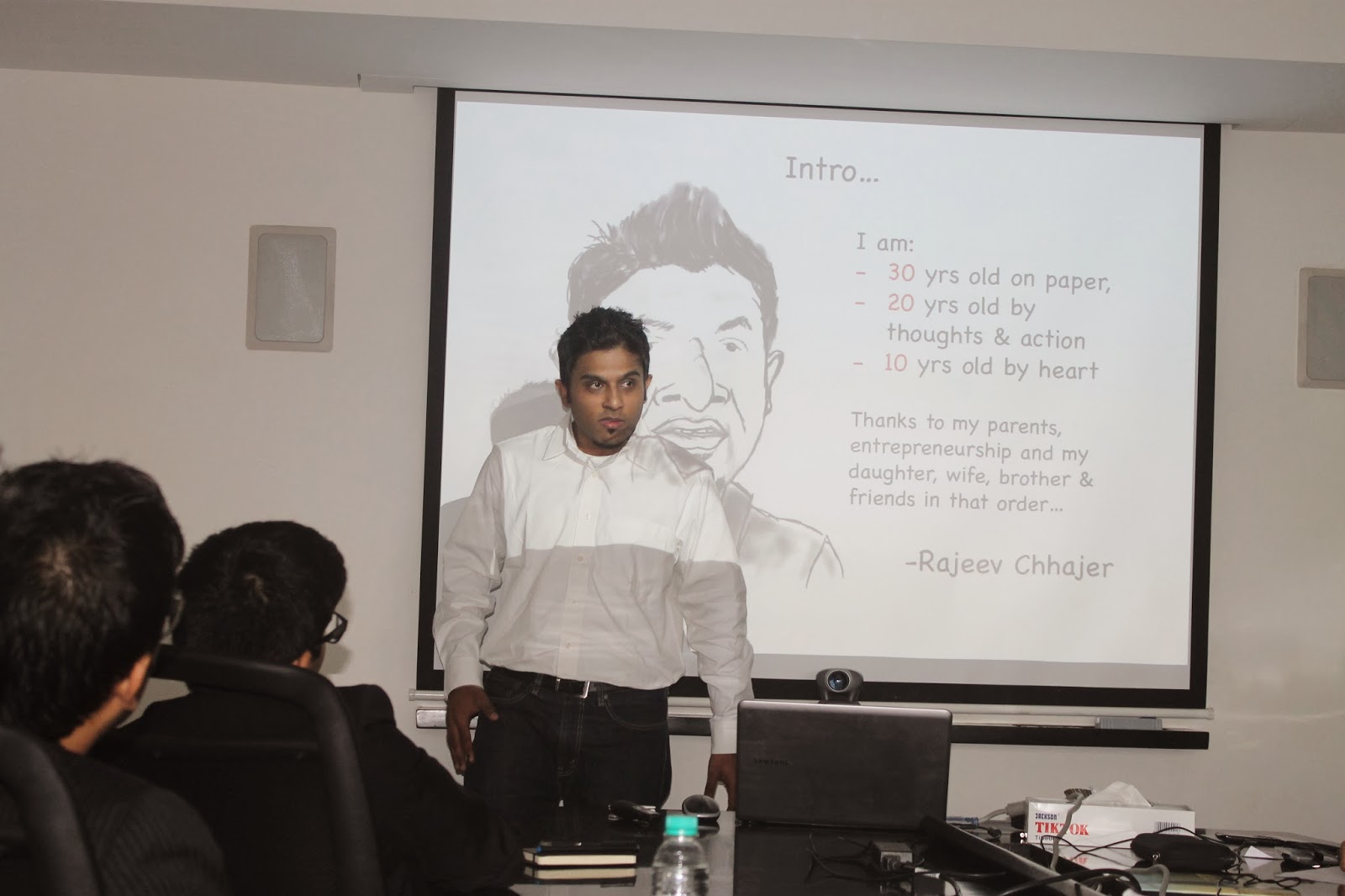
It was a couple months back when I heard about the Startup Leadership Program (http://www.startupleadership.com). I read about it, found it interesting and started reading more about how I could enroll. To my surprise, there was a selection process. This in a way was a roadblock because I was in no mood to write essays. Anyway, I thought about it deeper and somewhere I felt like this program would help me take my startup to a very different level so I took a stab at the essays and the admission form. With the daily grind, somewhere I forgot that I had applied. Finally, out of the blue I got a call and coordinator told me I got selected! Yippiee!! :-) I was really excited about this community!

As I write this blog, I'm somewhere in the middle of the entire 6 month program. The program has been very enlightening, eye-opening and a great learning experience. I've met some amazing and enthusiastic budding entrepreneurs, successful entrepreneurs and investors. Every session has so much to take away. We've covered topics on business plans, pitches, financial modeling, customer development, valuations, products, investments, lean methods, sales, customer development and many more exciting topics to come as we move ahead.

I got to meet with some very exciting entrepreneurs, Nischal from JustUnfollow, Sampad from Instamojo, Pravin from Wishberg, Kunal from Freecharge, Vikram from MyDentist, Mohit from Carwale, Sameer from CouponDunia, Vikram from yavvy.com and Bijaei from Loyalty Rewardz.

But I'd like to share my learnings till date and how I have implemented it within Last-Bench! One of our biggest strengths as a startup is that we have a strong, dependable and multi-talented team. It might not be large but it is a team whose strengths are diverse and individually each member, using their unique talent,  contributes to the business goals in a unified manner. One of our biggest weaknesses is the constant pivoting and loss of focus when trying to experiment with too many things.

As part of our lean method, the first thing we did was clearly identify the areas (product and services) we want to work on. We chose 1 product and 1 service that we wanted to focus on. This is helping us to be more focused and also allowing us to channel our energies in the right direction. Second, we've decided that each one manages his own time but wherever dependencies, that person is responsible to coordinate with the other people so that a bigger weekly goal is achieved. Third, we've started weekly targets that sum up to the bigger targets and everyone needs to report whether it is completed or not. There is no room to say that it is partially completed or 50-60% completed. If remaining, simply means it is not done. Fourth, we kept clear goals in terms of revenue and product development. Fifth, experimentation is key to find out whether a feature or a sales method will work for us or not. Sixth, there is no room for assumptions. Seventh and the most important, keep having fun while working!

Before and after every session I share the learnings with my team and everybody is excited to learn more. I personally think, a program like this, is definitely good for entrepreneurs who are in the 1st two years or to-be entrepreneurs. The biggest advantage that this program brings is the discipline!

Here are some pics from the sessions:


I will write more on this once the program ends and share my learning on each topic as we progress.

You can follow Rajeev on Twitter or connect with him via LinkedIn

Monday, December 2, 2013

Leader in focus: Warren Buffet

What really separates average leaders from the great ones? To get to a leadership position and, more importantly, to stay in one you not only require determination, courage and vision but also some very important skills to help you accomplish the work you are entrusted to complete. In business, it is equally important that you must be flexible and adaptive to constantly changing climates and demands. So is it possible to zero in on what is common between all great leaders? Can we learn from the way they plan, execute and achieve?

Thursday, November 28, 2013

A Sojourner's Tale

“My mind is in a state of constant rebellion. I believe that will always be so.” 
– George Leigh Mallory
The first question that any armed forced personnel asks a civilian at the Himalayan Mountaineering Institute (HMI) training camp is, ‘Why have you opted for this course?’ (It seems like the Basic/Advance Mountaineering course is more like a mini-vacation (with full respect) for them, after what they go through in the high altitude mountain ranges where they patrol for hours, day and night) And of course, us trying to show off, go saying, ‘Passion, love for the mountains, adventure, and all the good stuff!’ They don’t understand why one would go through so much of physical and mental stress for the sake of fun. And it’s true; mountaineering is not meant for everyone. It is demanding physically as well as mentally and a not to forget, requires a lot of luck!

HMI Entrance

HMI Campus Atrium


I had opted for the Basic Mountaineering Course (BMC 298 Batch) at The Himalayan Mountaineering Institute (HMI) in Darjeeling after a friend recommended the course. This was fueled by a lot of books and literature on mountaineering and expedition tales. The course was scheduled from 17th October 2013 to 16th November 2013. You require a lot of physical body conditioning prior to the training. Training would involve running at least 5 kms a day, walking flight of stairs for hours, trekking with at least 10-15 kgs in your rucksack. Coming from Mumbai, this still doesn’t prepare you for the actual stuff in the mountains. 

The first day of the course there were around 50+ students from all over India with various backgrounds (students, professionals, entrepreneurs, armed force personnel, etc). Students still kept pouring in till the 4th day at the institute and the final tally at the HMI base in Darjeeling was 64. Day 1, we were all divided in multiple groups or in mountain terminology ‘Ropes’, with one student being the rope leader and an instructor in charge. The instructors had varied backgrounds, some being from the armed forces and some local to Darjeeling. They were very well experienced, and some had even conquered the mighty Mt. Everest. The Course Director was Mr Lakpa Sherpa who’s reputation preceded him (An Everester as well as an accomplished climber for years). The first week consisted of early morning physical training and classroom sessions throughout the day. For a week we were not allowed to leave the institute for any reason. During the week we were allocated our mountain gear, consisting of cold weather gear and technical equipment. Fully loaded the rucksack weighed around 15+ kgs. Around day 6, they took us for an 11km (one way) hike to a place called ‘Tiger Hill’ (8600ft). You get a panoramic view of the Sikkim Himalayas including Everest and Makalu, but the weather didn’t work in our favor. The trek is supposed to be a prequel to what we would endure on our journey to the HMI basecamp in Sikkim. The trek also acts as a filter to exclude those who can’t make it this time from the main trip to the basecamp. And that’s what exactly happened, few students dropped out due to injury and/or personal reasons.

Personally, I started facing ligament issues in my knees (a past running injury) right at the beginning of the course. The downhill runs in Darjeeling simply aggravated the injury. In my head I thought my journey would end right before it started. But, after I mentioned this to one of the instructors, he asked me to take it easy for the next few days especially during the physical training. That did work for me, and I was able to complete the Tiger Hill trek successfully. But, the injury wasn’t the only setback to happen on the entire trip. There were more to follow. One of the days at the institute we had our medical tests done. Turned out that my blood pressure and my pulse rate were higher than usual. I was on a watch henceforth. I would go to medical office everyday and test my blood pressure and pulse rate. There were some other students with me who also face high blood pressure issues. Luckily my blood pressure had dropped to normal, but my pulse was still flying high. But, the doctor said it might be a one off case and let me continue the course. The others were not as lucky and were given the pink slip.

View from Tiger Hill (ref: Das Studio - Darjeeling)

On 26th October we left for our conquest. After a long drive and 3 days of hiking through the Kanchenjunga National Park we finally reached the HMI Basecamp alternatively known as Chowrikhang situated at an altitude of 4380m. I must admit the final stretch to the basecamp was never ending. It’s as if you can see your final goal, but it keeps evading you. In the mountains it’s really tough to estimate distance from one point to another. We reached the basecamp at around 3pm with the advance batch students waiting to receive us. Many advance students were kind enough to help students from our batch with their rucksacks. For the next 2 weeks other than your batch mates and your instructors these are the only faces you will see in the mountains (And ofcourse the guys working in the mess and helping with logistics).


One of the 4 majestic bridges in Kanchenjunga National Park

Enroute to Bakhim

Enroute to Dzongri

Mighty Mountains

The next 10 days at the basecamp consisted of various activities, which included technical training in snow/ice, rock climbing techniques, rescue techniques, etc. We were taken onto the Rathong glacier to implement the techniques we learnt during the open classroom sessions. I think personally, my favorite part of the glacier training was ice climbing. It was a dream come true after whatever I read about it in various mountaineering books. We got a chance to climb walls of sheer blue ice. During the training week at basecamp many students left voluntarily, while some left due to injuries. The final tally was now 48.


Tarn (Mountain Lake)

Headed towards Rathong glacier

Glacier training

Jumaaring

Doodh Pokhri Lake (HMI Advance Basecamp)

Selfie at 16000 ft

Gazing into oblivion

Infinite Knot (Buddhist Symbol)

In the mountains you start missing a lot of small things you take for granted in your day to day life. But eventually nothing matters. It's the final goal you need to work towards. There were days when I would question myself, as to 'Why am I doing this?' But deep down, you know you have the will to go through it. In the end it's just a mental battle. On the 10th day at the basecamp our Course Director decided that BMC 298 would attempt the B.C.Roy peak, which is around 17800ft. It was great news for us since this would the first attempt after 4 years. The weather conditions had turned out in favor of the climb. On 11th we head out towards the summit. It was a tiring journey but fruitful. Out of the remaining 48 students, 31 summited the peak that day. 


Summit of B.C.Roy peak - appx. 18000 ft

One the 13th we departed from the basecamp at Chowrikhang and were on our way back to Darjeeling. Two days of hiking included a trip through Dzongri and then Bakhim and finally to Yuksom. There onwards it was a bus ride to the institute. (The return journey was the most challenging for me, since my knees started bothering me and I had to complete the journey in the stipulated time. In times like these painkillers are a blessing.) The final few days at the institute in Darjeeling consisted of outings, competitions and the graduation ceremony.

'By learning to discover and value our ordinariness, we nurture a friendliness toward ourselves and the world that is the essence of a healthy soul.' 
 - Thomas Moore

This journey that started out as an adventure for me, a mere adrenalin rush, soon turned into a wake up call about the reality of life, as I was enveloped by the endless mountains. The opportunity to venture into nature and be separated from social structures (as we know it) was exceptional for me. To be able to gaze into the vast nothingness, introspect and ponder about life in general was truly medicine for my soul. Living in the mountains helps one realize how ordinary and insignificant man is, against mighty nature. You realize the worth of every single breath of air, every small drop of water, of human relationships and respect to all life beings. Life suddenly is in perspective and gradually with time it strikes you realize that whatever our actions may be, whatever our choices may be the truth is that Nature may very well remain without man but Man simply cannot exist without Nature. This understanding is the first step to embracing change, of the mind, body and soul. 

Monday, November 25, 2013

Leading Today's Business Organizations


The current business environment is extraordinarily challenging, competitive and dynamic. Companies need young professionals who can make an immediate impact on their organizations and also individually grow as the company is growing. Business knowledge, management & leadership skills are critical assets for success in almost any career. 

A lot of students entering the workforce or people already in the workforce are from non-business backgrounds such as engineering, science, medicine, arts or the finance streams and now find themselves on career tracks where they need to understand and “speak” the language of business fluently. Others are entrepreneurs who need to stay ahead of the curve in order for their business to succeed and grow. In any case, you need the business, management & leadership skills to advance your career to the next level.

In the past, when organizations followed a more pyramid-type structure, leaders were invested with far more formal authority. These leaders could issue directives, which would be funneled down through the various organizational ranks.  As such, the edicts issued by the leadership carried an enormous amount of organizational weight. Today’s organizations, however, are flatter. The degree of formal authority invested with leaders is much lower than before, and, given the modern-day organizational structure, many leaders do not particularly this authority particularly useful. Instead, they have learned to rely more on their own mastery of certain skills, and focus on learning and developing the same.

While different leaders follow different styles of leadership, there are certain common traits that every leader must possess. These include:
  • Communication skills: To speak and write persuasively
  • Interpersonal skills: To listen and hear what people are saying and react in constructive ways (active listening)
  • Conflict-resolution skills: To handle friction and inevitable tensions
  • Negotiation skills: To bring different groups together in order to reach mutually agreeable goals
  • Motivational skills: To align people who may not report to you toward a goal'
  • Decision-making skills: To take decisions in case of deadlock situations or move towards the larger goal
One of the biggest reasons why most people are so intimidated by the prospect of being a great leader is that only a few truly dare to lead. Indeed, taking up the mantle of leading a team of individuals, many of whom are talented, capable and opinionated, may seem like a daunting task for someone with little or no leadership experience. However, it is this willingness to take on a role and responsibility that others shy away from that sets the stage for a effective, powerful and admirable leader.

Most organizations today are desperately seeking such leaders who will not be afraid to act as pathfinders, visionaries and motivators, creating new avenues for growth for themselves, their teams and their organizations. More than ever, the need for good leaders is large and the opportunity great. To capitalize on this opportunity, however, you must first embrace the fact that leadership comprises multiple dimensions. It is a combination of personal characteristics and transformational behaviors that influence positive action in others. 


If you have any questions, comments or would like to learn more about any of the tools or techniques to improve your soft skills please write to us at chalktalk@last-bench.com

For more information on our skill development programs please click here.